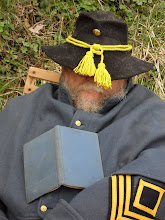
From the paper - Proper timing of priest burial in montane environments: A history and prospectus.
We were kicking grave side services around over on the Catholic Writers' list a while back (we had to because someone who will remain nameless' blasted dragon swallowed our political football) and it reminded me of a grave side service that involved a former boss--call him Kelly. Kelly put himself through art school working as an undertaker at a funeral home in Virginia's Blue Ridge Mountains.
One time, they had a Catholic burial that included a grave side service. The ground at the cemetery was so rocky the grave had to be dug with a backhoe, resulting in an over-sized hole. To give the priest a place to stand at the head of the coffin, boards covered over with fake grass carpeting were placed around the grave. The priest arrived a few minutes before the family. Father was a bit old-fashioned and wore a biretta. As the family approached from the parking lot at the bottom of the hill, the priest stepped to the head of the coffin and vanished. Kelly and his assistant whirled and looked in all directions. Kelly said that he happened to glance down and there was Father's biretta sticking up out from beneath the coffin. Apparently, the priest had stepped on a spot were two boards had moved apart and gravity took it's course. While his assistant ran down the hill to stop the family, Kelly helped Father from the hole. The service was conducted by the mud bespattered clergyman without further entertainment. According to Kelly, Father took it well, for the most part, remarking that to be a good priest, one had to throw oneself into it. He also said while it (pointing to the grave) was the destination of all, he really hadn't expected to get there quite that fast.
As a Note,
The last passenger pigeon, a female, died in the Cincinnati Zoo on this day in 1914. During the 19th century, single flocks of over 2 billion covering an area of 1 mile (1.6 km) by 300 miles (500 km) were counted (estimated?) during migrations. Rather than being wiped out by sports hunters, they were destroyed by market hunters who shipped boxcar loads the eastern U.S. cities for the restaurant trade . Leaving this country boy with one question: Did y'all enjoy y'all's supper?
Certainly makes one appreciate the conservation work done by and paid for through donations, license fees, and taxes on ammunition by sports hunters through organizations such as Ducks Unlimited and others.
Thus endeth today's lesson.
Also on this day, something happy. Alberta, bringing with it one of the richest dinosaur fossil deposits around the Red Deer River, joined the rest of the Canadian confederation. Oh, yeah, Saskatchewan joined too--but they seem to have a dearth of dinosaurs. If you ever get the chance, check out Drumheller and the Royal Tyrrell Museum.
1 September 2010. Feast of St. Lupus of Sens. Montrose defeats Covenanters in Battle of Tippermuir 1644, Mission San Luis Obispo de Tolosa founded 1772, Germans capture Emperor Napoleon III of France at Battle of Sedan 1870, Tokyo and Yokohama destroyed by Great Kanto earthquake 1923, Germany invades Poland 1939.
Showing posts with label 19th century. Show all posts
Showing posts with label 19th century. Show all posts

"What's in a name?"
"To name something is to own it." This is an old idea from the beginning of time. If you can name something, not only can you describe it, you can possibly control it. This why among people who believe in magic and witchcraft, most have a secret or "spirit" name that is only known to them and a select few.
Naming conventions is something a fiction writer needs to keep in mind when introducing his or her characters to the reader. How people name their children and how those children identify themselves will tell a lot about the culture.
In medieval Europe the rise of family names came from people being known by their occupation, a feature, where they lived ("Miller," "Fuller," "Long," "Short," "Bridges," "London," "Longbottom") or who they were related to ("Watson," "Fitzhugh," "Brothersson [that one I don't think I want to look too closely at]"). As a note, in Iceland four members of a nuclear family can have four different last names such as Rorick Erikson, his wife Feya Jorgansdaughter, and their childern Erik Rorickson and Trondi Roricksdaughter (something that gives an Icelandic phone book a slightly higher page count than War and Peace).
The Romans seemed to have a dearth of names that were fashionable over the millennium their republic and empire lasted. To paraphrase Sam Goldwin, "Every Tom, Dick, and Harry was named Gaius." It seems there were only about eight names used for boys and approximately the same number for girls. This led one barbarian chieftain to remark, "The Romans must be a poor people as they can afford so few names to chose from." With everyone named pretty much the same thing, the Romans had to resort to nicknames and qualifiers such as "the elder/the younger," "Black/florid/tall/short/fat," "The African/Thracian/Iberian," etc (which somewhat puts the lie to "Roman efficiency"). The same sort of thing arose among the men who fought the War Between the States. So many were either named John or something outlandish that, like the Romans, most ended up known more by their nicknames (Ulysses Simpson Grant and John Bell Hood were "Sam" as an example) or used their middle name (William Dorsey Pender was known to his contemporaries and history usually just as Dorsey Pender--one of the uncles on my father's side and our cat of the moment were named "Dorsey" for him). In the movie "Zulu," the fact so many Welshmen were named William Jones is highlighted in the practice in Welsh regiments of using a portion of their service number as a qualifier ("2451 Jones" or "Jones 6325"). We ran into something like this in a medievalist group I belonged to. We had three "Roricks," "Rorick Rorickson," "Rorick the Long," and the luckiest of all, "Rorick Joanna's Husband."
Another name use convention I've found notably within three groups is the first two initials used rather than first and second name. Quite often when you run across such, there is a fair chance that the person (male usually) is either a Russian, an Indian (from the subcontinent rather than Amerindian), or worked for the Norfolk and Western Railway.
If you write crime, keep in mind dang near everybody on the street goes by a nickname. Part of this just a natural human affinity for such and part is because there are a lot of dudes out there you just don't want to know your real name. There's also the "AKA" factor (Also Known As). Multiple aliases are the norm (without such, police files that take up three floors could probably be kept in one file cabinet with a drawer left over for munchies and another for girlie magazines). As one cop said, "Everybody on the street's got a name."
There is also the divide between East and West. In eastern Asia, the family name comes first followed by the given names. In my young and more foolish days, this used to trip me up when doing research on that area. As I have to read in translation, whether the family name came first or last (and Lord help me, I even came across one in which it was sandwiched between two given names) seemed totally at the whim of an editor in either New York or London. Before I wised up, I wasted time looking for information on Saburo Sakai under what I thought was the family name, "Saburo"--which is kind of like trying to look up James Longstreet under "Jimmy (by the way, he went by "Pete")."
For the writer, naming characters gives you a certain power. The name can describe their inner person (Dickens' name picks immediately pops to mind), make them ridiculous ("Major Minor," "Private Means,"), show how life treats them (Joseph Heller's "Major Major Major"), or you can honor someone (my naming of spacecraft such as the survey vessel Alfred L. Wegener or the "Hero" class destroyers Kevin Barry and Todd Beamer). The guys in England who translated Rene Goscinny and Albert Uderzo's French comic "Asterix the Gaul" had a field day with this with folks like the Roman commander, Cumulus Nimbus, the over weight Goth, Hemispheric, the Greek Mercenary, Neverataloss, and the confused Egyptian vacationer, Ptennisnet (personally, I think the Druid's name "Readymix" in the American translation used during the comic's short run in U.S. newspapers was funnier than the Brit "Getafix"). I've noticed that Karina Fabian's elves in her Dragoneye, P.I. series have the same lamentable taste in names as Neverataloss' parents.
One thing a writer should probably have little fear of is coming up with a name that nobody would give their kid. Looking at some names will convince you that either all their taste was in their mouth or they must have hated their offspring. I remember a lady who had to go through life as Rose Thorn--naturally, she married a guy named Bush.
3 February 2010: Feast of St. Liafdag of Jutland. Spain recognizes U.S. 1783, Meiji Emperor enthroned - Tokyo 1867, Earthquake - Hawke's Bay, New Zealand 1931, U.S. Marines and Army capture Kwajalein 1944.
Naming conventions is something a fiction writer needs to keep in mind when introducing his or her characters to the reader. How people name their children and how those children identify themselves will tell a lot about the culture.
In medieval Europe the rise of family names came from people being known by their occupation, a feature, where they lived ("Miller," "Fuller," "Long," "Short," "Bridges," "London," "Longbottom") or who they were related to ("Watson," "Fitzhugh," "Brothersson [that one I don't think I want to look too closely at]"). As a note, in Iceland four members of a nuclear family can have four different last names such as Rorick Erikson, his wife Feya Jorgansdaughter, and their childern Erik Rorickson and Trondi Roricksdaughter (something that gives an Icelandic phone book a slightly higher page count than War and Peace).
The Romans seemed to have a dearth of names that were fashionable over the millennium their republic and empire lasted. To paraphrase Sam Goldwin, "Every Tom, Dick, and Harry was named Gaius." It seems there were only about eight names used for boys and approximately the same number for girls. This led one barbarian chieftain to remark, "The Romans must be a poor people as they can afford so few names to chose from." With everyone named pretty much the same thing, the Romans had to resort to nicknames and qualifiers such as "the elder/the younger," "Black/florid/tall/short/fat," "The African/Thracian/Iberian," etc (which somewhat puts the lie to "Roman efficiency"). The same sort of thing arose among the men who fought the War Between the States. So many were either named John or something outlandish that, like the Romans, most ended up known more by their nicknames (Ulysses Simpson Grant and John Bell Hood were "Sam" as an example) or used their middle name (William Dorsey Pender was known to his contemporaries and history usually just as Dorsey Pender--one of the uncles on my father's side and our cat of the moment were named "Dorsey" for him). In the movie "Zulu," the fact so many Welshmen were named William Jones is highlighted in the practice in Welsh regiments of using a portion of their service number as a qualifier ("2451 Jones" or "Jones 6325"). We ran into something like this in a medievalist group I belonged to. We had three "Roricks," "Rorick Rorickson," "Rorick the Long," and the luckiest of all, "Rorick Joanna's Husband."
Another name use convention I've found notably within three groups is the first two initials used rather than first and second name. Quite often when you run across such, there is a fair chance that the person (male usually) is either a Russian, an Indian (from the subcontinent rather than Amerindian), or worked for the Norfolk and Western Railway.
If you write crime, keep in mind dang near everybody on the street goes by a nickname. Part of this just a natural human affinity for such and part is because there are a lot of dudes out there you just don't want to know your real name. There's also the "AKA" factor (Also Known As). Multiple aliases are the norm (without such, police files that take up three floors could probably be kept in one file cabinet with a drawer left over for munchies and another for girlie magazines). As one cop said, "Everybody on the street's got a name."
There is also the divide between East and West. In eastern Asia, the family name comes first followed by the given names. In my young and more foolish days, this used to trip me up when doing research on that area. As I have to read in translation, whether the family name came first or last (and Lord help me, I even came across one in which it was sandwiched between two given names) seemed totally at the whim of an editor in either New York or London. Before I wised up, I wasted time looking for information on Saburo Sakai under what I thought was the family name, "Saburo"--which is kind of like trying to look up James Longstreet under "Jimmy (by the way, he went by "Pete")."
For the writer, naming characters gives you a certain power. The name can describe their inner person (Dickens' name picks immediately pops to mind), make them ridiculous ("Major Minor," "Private Means,"), show how life treats them (Joseph Heller's "Major Major Major"), or you can honor someone (my naming of spacecraft such as the survey vessel Alfred L. Wegener or the "Hero" class destroyers Kevin Barry and Todd Beamer). The guys in England who translated Rene Goscinny and Albert Uderzo's French comic "Asterix the Gaul" had a field day with this with folks like the Roman commander, Cumulus Nimbus, the over weight Goth, Hemispheric, the Greek Mercenary, Neverataloss, and the confused Egyptian vacationer, Ptennisnet (personally, I think the Druid's name "Readymix" in the American translation used during the comic's short run in U.S. newspapers was funnier than the Brit "Getafix"). I've noticed that Karina Fabian's elves in her Dragoneye, P.I. series have the same lamentable taste in names as Neverataloss' parents.
One thing a writer should probably have little fear of is coming up with a name that nobody would give their kid. Looking at some names will convince you that either all their taste was in their mouth or they must have hated their offspring. I remember a lady who had to go through life as Rose Thorn--naturally, she married a guy named Bush.
3 February 2010: Feast of St. Liafdag of Jutland. Spain recognizes U.S. 1783, Meiji Emperor enthroned - Tokyo 1867, Earthquake - Hawke's Bay, New Zealand 1931, U.S. Marines and Army capture Kwajalein 1944.
Odds and ends mostly.
A voice from the past:
"God damn all mathematics to the lowest depts. (sic) of hell!! May it be capable of bodily suffering & undergo such torments that the veriest fiend in hell shall shrink in horror at the sight."
Scribbled in a West Point calculus book apparently by a cadet sometime between 1832 and 1850. In Cavalryman of the Lost Cause: A Biography of J.E.B. Stuart. Jeffry D. Wert. New York: Simon & Schuster, 2008. Kindle.
Who sez soldiers are devoid of religious hope?
Catholic Writers Conference Online
Registration for Free Catholic Writers Conference Online Ends Feb 15
World Wide Web--Are you a Catholic writer? Looking for an opportunity to learn more about writing and marketing, a chance to meet like-minded authors, and get an opportunity to pitch your work? Want it all for free--and without leaving your home? The Catholic Writers' Conference Online, which will be held February 26-March 5, 2010, is for you. Hurry, though--registration ends Feb 15.
The conference is held via chats and forums at http://www.catholicwritersconference.com . Sponsored by the Catholic Writer's Guild, the online conference is free of charge and open to writers of all level who register before February 15, 2010.
"Each year, we have about 300 writers and around 50 presenters participate," said organizer Karina Fabian. "This year, we're thrilled to have added small-group critique sessions with well-established authors and editors, plus more pitch sessions than ever before!"
Publishers hearing pitches include well known Catholic publishers like Pauline Books and Media, large Christian publishers like Thomas Nelson, and small secular presses like White Rose. Thus far, eleven pitch sessions are scheduled, running gamut from Christian romance to Catholic theology.
In a new program, dozens of attendees will have the opportunity to have pieces of their work critiqued by successful editors and writers. n addition, there will be forum-based workshops and chat room presentations covering topics from dialogue to freelancing to how Catholic fiction differs from Christian fiction.
"Even in good times, it's hard for writers to attend live conferences," said Fabian, "but this year, we think it's even more important to help careers by utilizing an online format. We're so grateful that our presenters are willing to share their time and talent."
Although the conference is offered free of charge, donations are accepted; proceeds will go toward future conferences. For a $10 donation, one receives a copy of the conference e-book containing chat transcripts, forum workshop posts, handouts or informational materials from the conference. Non-Catholics may attended, as long as they respect catholic beliefs and the conference's Catholic focus.
To register or for more information, go to http://www.catholicwritersconference.com
As a note, the Catholic Writers' Conference Online 2009 is that which began me writing once more after a hiatus of eighteen years (no doubt, there are those who may see this as an argument against the existence of the CWCO). For those worried that this is purely a collection of Mackerel-Snappers, a number of heavy-duty Protestant writers, editors, and publishers will be present and presenting. On the whole, we get along pretty well.
26 January 2010: Feast of St. Alberic the Cistercian. British First Fleet under Arthur Phillip establishes Sidney - Australia Day 1788, Hooker replaces Burnside 1863, The Mahdi takes Khartoum - "Chinese" Gordon killed 1885, Franco's Nationalists capture Barcelona 1939.
"God damn all mathematics to the lowest depts. (sic) of hell!! May it be capable of bodily suffering & undergo such torments that the veriest fiend in hell shall shrink in horror at the sight."
Scribbled in a West Point calculus book apparently by a cadet sometime between 1832 and 1850. In Cavalryman of the Lost Cause: A Biography of J.E.B. Stuart. Jeffry D. Wert. New York: Simon & Schuster, 2008. Kindle.
Who sez soldiers are devoid of religious hope?
Catholic Writers Conference Online
Registration for Free Catholic Writers Conference Online Ends Feb 15
World Wide Web--Are you a Catholic writer? Looking for an opportunity to learn more about writing and marketing, a chance to meet like-minded authors, and get an opportunity to pitch your work? Want it all for free--and without leaving your home? The Catholic Writers' Conference Online, which will be held February 26-March 5, 2010, is for you. Hurry, though--registration ends Feb 15.
The conference is held via chats and forums at http://www.catholicwritersconference.com . Sponsored by the Catholic Writer's Guild, the online conference is free of charge and open to writers of all level who register before February 15, 2010.
"Each year, we have about 300 writers and around 50 presenters participate," said organizer Karina Fabian. "This year, we're thrilled to have added small-group critique sessions with well-established authors and editors, plus more pitch sessions than ever before!"
Publishers hearing pitches include well known Catholic publishers like Pauline Books and Media, large Christian publishers like Thomas Nelson, and small secular presses like White Rose. Thus far, eleven pitch sessions are scheduled, running gamut from Christian romance to Catholic theology.
In a new program, dozens of attendees will have the opportunity to have pieces of their work critiqued by successful editors and writers. n addition, there will be forum-based workshops and chat room presentations covering topics from dialogue to freelancing to how Catholic fiction differs from Christian fiction.
"Even in good times, it's hard for writers to attend live conferences," said Fabian, "but this year, we think it's even more important to help careers by utilizing an online format. We're so grateful that our presenters are willing to share their time and talent."
Although the conference is offered free of charge, donations are accepted; proceeds will go toward future conferences. For a $10 donation, one receives a copy of the conference e-book containing chat transcripts, forum workshop posts, handouts or informational materials from the conference. Non-Catholics may attended, as long as they respect catholic beliefs and the conference's Catholic focus.
To register or for more information, go to http://www.catholicwritersconference.com
As a note, the Catholic Writers' Conference Online 2009 is that which began me writing once more after a hiatus of eighteen years (no doubt, there are those who may see this as an argument against the existence of the CWCO). For those worried that this is purely a collection of Mackerel-Snappers, a number of heavy-duty Protestant writers, editors, and publishers will be present and presenting. On the whole, we get along pretty well.
26 January 2010: Feast of St. Alberic the Cistercian. British First Fleet under Arthur Phillip establishes Sidney - Australia Day 1788, Hooker replaces Burnside 1863, The Mahdi takes Khartoum - "Chinese" Gordon killed 1885, Franco's Nationalists capture Barcelona 1939.
"Gentlemen, it is to be war."
Main battles picked for 150th anniversary observance of the War Between the States/American Civil War.
A mite late for Lee-Jackson Day, but the American Civil War re-enactor groups' leaders have decided which battle re-enactments will be endorsed. Meeting in Chickamauga, Georgia, members of the Civil War 150th National Leadership Convention representing 12,000 re-enactors voted for the following battle observances:
2011
First Manassas/Bull Run -- Virginia
Shiloh -- Tennessee
2012
Second Manassas/Bull Run -- Virginia
Vicksburg -- Mississippi
2013
Gettysburg -- Pennsylvania
Chickamauga -- Georgia
2014
The Wilderness -- Virginia
Atlanta -- Georgia
2015
Bentonville -- North Carolina
Appomattox Court House -- Virginia
I used to take part in re-enacting back when I could move around better. I was a private in a Virginia Volunteer Infantry company or a Pennsylvania Volunteer Infantry company (depending on which side was needed more--Federals outnumbered four to one by Confederates is just silly). After a while, I got old and tired and my case of Civil War bloat was just too embarrassing [see note]. Now adays, on those rare occasions I can get outside to attend a re-enactment, I stand on the sidelines with the other gawkers and dream. If I can manage it, I plan to see the sesquicentennial through as I did the centennial, though I admit the bicentennial might possibly be a bit of a stretch.
Note: Civil War Bloat.
Civil War bloat is a condition in which the re-enactor appears to has been dead in the sun for three days during the hot summer of 1863 while still standing up. It is brought on by age, a lack of regular exercise, and a wife who is far too good a cook. It is especially weird looking when the affected soldier is dressed in gray or butternut (putting the lie to the hard times in the South). The overly common amount of gray hair (if any) that often accompanies it also calls into question the fact that the men on both sides normally ranged in age from 16 to 35. This condition effects not only Civil War re-enactors, but those of many other periods. I've noted it at Alesia, Waterloo, Rorke's Drift, the Somme, and Normandy. The problem is old guys are the ones who have the bucks to shell out $600 for their wool trousseau (uniform, equipment, and rifle musket) and the time to burn on summer weekends out in the middle of nowhere (the young guys seem rather more intent on chasing girls for some reason).
Occasionally though, one does run across a unit of young, dirty, sweaty, ragged, skinny men in gray or blue and one realizes he is looking at his own great-great grandfather.
22 January 2010: Feast of St. Brithward of Ramsbury. Ashantis defeat British on Gold Coast 1824, Battles of Isandlwana and Rorke's Drift 1879, Commonwealth forces capture Tobruk from Italians 1941, Anzio landings 1944.
A mite late for Lee-Jackson Day, but the American Civil War re-enactor groups' leaders have decided which battle re-enactments will be endorsed. Meeting in Chickamauga, Georgia, members of the Civil War 150th National Leadership Convention representing 12,000 re-enactors voted for the following battle observances:
2011
First Manassas/Bull Run -- Virginia
Shiloh -- Tennessee
2012
Second Manassas/Bull Run -- Virginia
Vicksburg -- Mississippi
2013
Gettysburg -- Pennsylvania
Chickamauga -- Georgia
2014
The Wilderness -- Virginia
Atlanta -- Georgia
2015
Bentonville -- North Carolina
Appomattox Court House -- Virginia
I used to take part in re-enacting back when I could move around better. I was a private in a Virginia Volunteer Infantry company or a Pennsylvania Volunteer Infantry company (depending on which side was needed more--Federals outnumbered four to one by Confederates is just silly). After a while, I got old and tired and my case of Civil War bloat was just too embarrassing [see note]. Now adays, on those rare occasions I can get outside to attend a re-enactment, I stand on the sidelines with the other gawkers and dream. If I can manage it, I plan to see the sesquicentennial through as I did the centennial, though I admit the bicentennial might possibly be a bit of a stretch.
Note: Civil War Bloat.
Civil War bloat is a condition in which the re-enactor appears to has been dead in the sun for three days during the hot summer of 1863 while still standing up. It is brought on by age, a lack of regular exercise, and a wife who is far too good a cook. It is especially weird looking when the affected soldier is dressed in gray or butternut (putting the lie to the hard times in the South). The overly common amount of gray hair (if any) that often accompanies it also calls into question the fact that the men on both sides normally ranged in age from 16 to 35. This condition effects not only Civil War re-enactors, but those of many other periods. I've noted it at Alesia, Waterloo, Rorke's Drift, the Somme, and Normandy. The problem is old guys are the ones who have the bucks to shell out $600 for their wool trousseau (uniform, equipment, and rifle musket) and the time to burn on summer weekends out in the middle of nowhere (the young guys seem rather more intent on chasing girls for some reason).
Occasionally though, one does run across a unit of young, dirty, sweaty, ragged, skinny men in gray or blue and one realizes he is looking at his own great-great grandfather.
22 January 2010: Feast of St. Brithward of Ramsbury. Ashantis defeat British on Gold Coast 1824, Battles of Isandlwana and Rorke's Drift 1879, Commonwealth forces capture Tobruk from Italians 1941, Anzio landings 1944.
Of Women, Bucks, and Why They Ain't Got 'Em.
I'm pretty much a guy (quick look down). Yeah, a guy. But I have been known to associate with women (two are asleep a few meters away as I write this). Over the years, I've come to the opinion that they are heavily taken advantage of in this society. Reading an article at oh-dark-thirty this morning reminded me of this (not to mention getting my skivies in a knot). Here's the article: http://articles.moneycentral.msn.com/SavingandDebt/ConsumerActionGuide/dunleavey-why-it-costs-more-to-be-a-woman.aspx
Since I've been married (34 years and counting) I've noticed that women are sold poorly made clothing for much more than well made men's clothing. The coats are thinner, the pants start unraveling on the first wearing, and the socks have toes coming through them before the mates vanish in the dyer. One reason women are always cold--I had a scientific treatise about this on the blog sometime ago you may remember--is that their winter clothes are apparently made of cheese cloth or, at least, cheesy cloth. The only companies I've run across that seem to consistently sell clothing for women to wear outside in temperate and frigid areas at anytime other than summer are Cabela's http://www.cabelas.com and L.L.Bean http://www.llbean.com . The prices are generally no worse than the mall and the quality is a heck of a lot better.
Why does this sort of thing go on? Because women put up with it. Women rarely make a stink about how they're taken advantage of. Yeah, there's some griping to each other, but nothing really gets done other than a bit of venting. The people who make a living out of being women professionally seem to spend a large part of their time pursuing grants and agitating for various amorphous "rights" but never seem to address the fact it costs a woman 50% more to live than a man. Occasionally, one will hear them complain about women being paid 80% what guys are for doing the same jobs (the fastest way to lower payroll costs in any profession is to attract women to it). Okay, but let's hear more about women's other economic problems as well.
I don't think much of anything will change until women vote with their pocketbooks. As long as producers can mold a razor in pink plastic and know they can sell it for 50% more, nothing's going to happen. When women start buying the same razor in white, blue, or even Advantage HD camouflage (which, by the way, is rather fetching), the producer will get the message. As an example, the ladies in my life shop in the Men's department for those things that don't require frilliness: socks, t-shirts, long johns, backpacks, even some of their shoes. Does it make them any less feminine? Nope, just shows them to be women who are too smart to pay more for the sake of their gender. Me? I likes my women smart.
Review: (Note to FTC: I bought this dang book myself!)
Lee's Lieutenants: A Study in Command. Douglas Southall Freeman. Abridged in one volume by Stephen W. Sears. New York: Simon & Schuster, 1998. Kindle.
As a general rule, when confronted with an abridgement, I retreat precipitously (yeah, okay, I admit it does usually look more like a rout). Due to a malfunction of my port side manipulator, I'm forced to read on my Kindle as I'm unable to hold a book until I get out of drydock. I felt like reading something on the War Between the States (American Civil War to you folks of a Northern persuasion), but had already read James M. McPherson's book on Sharpsburg, Crossroads of Freedom: Antietam, and didn't have the bucks to download Edward Longacre's biography of the Federal cavalry commander who sparked Gettysburg and saved the Union, General John Buford: A Military Biography. I had downloaded Sears' abridgement of Freeman's three volume work published in 1942, '43, and '44 last summer at the same time I downloaded an abridgement of Freeman's four volume Pulitzer Prize winning R.E. Lee, and had never gotten around to looking at it.
Okay, I admit it. I own the three volume set and to be honest, I haven't been able to really tell the difference between the two other than (I think) Sears has kept most of the actual matter on command and dumped some of the biographical detail, necessary redundancies connecting volumes, and notes. He has kept enough of the biographies to give a good idea of the Army of Northern Virginia's general officers. He hasn't touched Freeman's voice or style and hasn't attempted to update him--for which I have warm, fuzzy feelings for Mr. Sears.
James M. McPherson is at his usual best in his Introduction.
Freeman is always a pleasure to read and Stephen W. Sears did a heck of a job lightening Lee's Lieutenants without cutting either bone or muscle.
Note: Amazon.com's free Kindle for PC download is a big help. When I tire of holding the Kindle, it allows me to read any of my Kindle formatted books (including those from Baen and ManyBooks.net) sitting at the laptop or desktop.
8 January 2010: Feast of St. Thorfinn of Trondhjem, Ethelred of Wessex defeats Danes 871, Charles Stuart takes Stirling 1746, Battle of New Orleans 1815, Crazy Horse and Two Moons defeated at Wolf Mountain by Nelson A. Miles 1877.
Since I've been married (34 years and counting) I've noticed that women are sold poorly made clothing for much more than well made men's clothing. The coats are thinner, the pants start unraveling on the first wearing, and the socks have toes coming through them before the mates vanish in the dyer. One reason women are always cold--I had a scientific treatise about this on the blog sometime ago you may remember--is that their winter clothes are apparently made of cheese cloth or, at least, cheesy cloth. The only companies I've run across that seem to consistently sell clothing for women to wear outside in temperate and frigid areas at anytime other than summer are Cabela's http://www.cabelas.com and L.L.Bean http://www.llbean.com . The prices are generally no worse than the mall and the quality is a heck of a lot better.
Why does this sort of thing go on? Because women put up with it. Women rarely make a stink about how they're taken advantage of. Yeah, there's some griping to each other, but nothing really gets done other than a bit of venting. The people who make a living out of being women professionally seem to spend a large part of their time pursuing grants and agitating for various amorphous "rights" but never seem to address the fact it costs a woman 50% more to live than a man. Occasionally, one will hear them complain about women being paid 80% what guys are for doing the same jobs (the fastest way to lower payroll costs in any profession is to attract women to it). Okay, but let's hear more about women's other economic problems as well.
I don't think much of anything will change until women vote with their pocketbooks. As long as producers can mold a razor in pink plastic and know they can sell it for 50% more, nothing's going to happen. When women start buying the same razor in white, blue, or even Advantage HD camouflage (which, by the way, is rather fetching), the producer will get the message. As an example, the ladies in my life shop in the Men's department for those things that don't require frilliness: socks, t-shirts, long johns, backpacks, even some of their shoes. Does it make them any less feminine? Nope, just shows them to be women who are too smart to pay more for the sake of their gender. Me? I likes my women smart.
Review: (Note to FTC: I bought this dang book myself!)
Lee's Lieutenants: A Study in Command. Douglas Southall Freeman. Abridged in one volume by Stephen W. Sears. New York: Simon & Schuster, 1998. Kindle.
As a general rule, when confronted with an abridgement, I retreat precipitously (yeah, okay, I admit it does usually look more like a rout). Due to a malfunction of my port side manipulator, I'm forced to read on my Kindle as I'm unable to hold a book until I get out of drydock. I felt like reading something on the War Between the States (American Civil War to you folks of a Northern persuasion), but had already read James M. McPherson's book on Sharpsburg, Crossroads of Freedom: Antietam, and didn't have the bucks to download Edward Longacre's biography of the Federal cavalry commander who sparked Gettysburg and saved the Union, General John Buford: A Military Biography. I had downloaded Sears' abridgement of Freeman's three volume work published in 1942, '43, and '44 last summer at the same time I downloaded an abridgement of Freeman's four volume Pulitzer Prize winning R.E. Lee, and had never gotten around to looking at it.
Okay, I admit it. I own the three volume set and to be honest, I haven't been able to really tell the difference between the two other than (I think) Sears has kept most of the actual matter on command and dumped some of the biographical detail, necessary redundancies connecting volumes, and notes. He has kept enough of the biographies to give a good idea of the Army of Northern Virginia's general officers. He hasn't touched Freeman's voice or style and hasn't attempted to update him--for which I have warm, fuzzy feelings for Mr. Sears.
James M. McPherson is at his usual best in his Introduction.
Freeman is always a pleasure to read and Stephen W. Sears did a heck of a job lightening Lee's Lieutenants without cutting either bone or muscle.
Note: Amazon.com's free Kindle for PC download is a big help. When I tire of holding the Kindle, it allows me to read any of my Kindle formatted books (including those from Baen and ManyBooks.net) sitting at the laptop or desktop.
8 January 2010: Feast of St. Thorfinn of Trondhjem, Ethelred of Wessex defeats Danes 871, Charles Stuart takes Stirling 1746, Battle of New Orleans 1815, Crazy Horse and Two Moons defeated at Wolf Mountain by Nelson A. Miles 1877.
Lessons from the Muse Online: Part 1
I attended the 2009 Muse Online Writers Conference this Fall. This is part 1 of the work I did for the workshop "World Building in Science Fiction and Fantasy." We started off with a Q & A in which we had to ask ourselves a series of questions to help us develop our settings.
Q. You're writing about the military mostly from the view from the grunt up to the battalion commander (usually a major or light colonel). Why?
A. That's the level I have the most experience with.
Q. Are you writing about armies?
A. No, smaller types of organizations. so far, Fallschirmjagers (drop-troops or future paratroopers who drop from orbit) from Bayern, horse cavalry from High Brazos, Imperial Erin Marines, and the crew of an Imperial Erin destroyer.
Q. Why smaller groups?
A. Camaraderie is usually higher and 'characters" are more likely to end up in such units ("You're asking this of a man who leaves a perfectly good spacecraft to drop from orbit in an egg just so people can shoot at him?").
Q. What kind of situation could a series of short stories be written about?
A. Insurgency tends to be best written about in small chunks, invasions often need a novella, and campaigns require a book. The bigger the operation, the larger the canvas.
Q. What sort of POV?
A. Probably 3rd person limited is best. If you go for 1st person, your narrator has to be everywhere action is taking place. Besides, with 3rd limited, you can occasionally (very occasionally) do a little head-hopping--It's always fun to look at the problems the guy on the other side of the hill is having.
Q. Who's the good guy?
A. That depends on the situation. Normal people tend to think of themselves as the "good guy" (George McDonald Fraser's Harry Flashman doesn't count). It's my job as the writer to limn the characters and their actions in such away that the reader can understand them.
Q. how close to real life can you fly without people reading into the situations and characters commentary you don't intend?
A. as I'm writing about a counterinsurgency, I figure I should make the setting as different from the settings of those going on in the real world as possible.
In my stories, "Words of Rust," "Electronic Propagation," and "Marine Diplomacy," Arkm is described as an "ice world" or "ice ball." In the area my stories are set, the terrain is mostly low-relief. The only heights that have shown up are a dormant shield volcano. As the stories are told from the view point of soldiers fighting an insurgency, the actual science of the planetology hasn't really come up. I see it mostly in this case as something I have to be aware of so nothing jarring jumps up and smacks the reader.
One of my reasons for Arkm's climate and geomorphology was, because I am writing about a counterinsurgency, I wanted to disconnect the stories from things going on at present as much as possible. Because of the subject matter, there will be commonalities. Soldiers have been pretty much the same for the last 8,000 plus years. By definition, insurgency-counterinsurgency has features that don't change (otherwise, it would be some other form of mutual mayhem).
I'll develop Arkm more in part 2.
Review (Note to FTC: I bought this dang book myself!)
Forty Miles a Day on Beans and Hay. by Don Rickey, Jr. Norman, OK: University of Oklahoma Press, 1987.
I've always been a sucker for John Ford's cavalry trilogy: "Fort Apache (1948)," "She Wore a Yellow Ribbon (1949)," and "Rio Grande (1950)." While the cavalrymen were a little better matched in their uniforms when out on patrol (I believe it was Remington who remarked that no two were dressed alike normally), they gave the "right" impression of the soldier's lot--dirt, sweat, exhaustion, and the chance to die in a nameless little clash.
Don Rickey, Jr.'s Forty Miles a Day on Beans and Hay looks at the life of the frontier Regulars from 1865 to the mid 1890s. Unlike many books on this subject and period, it concentrates on the enlisted man's experience. Officers, of course, appear throughout, but it is their interaction with the man in the ranks. The book begins with the enlistment and, almost immediately, one learns what anyone who's been around the military knows, there are the regulations and there is the way things actually work as the recruiter works his magic.
The soldier was often hungry and a look at his diet--dry bread, black coffee, salt beef, (if he was lucky) beans, and hard tack (this was a hard, heavy, plastic-like cracker allegedly made from wheat--men have been known to be killed when hit by a thrown one)--lend convincing proof that our ancestors were a hardy lot. When combined with the knowledge that a private made a princely $13 per month, the fact that the enlistees looked upon such a life as an improvement over that of a civilian is frightening. After reading this section, one may never look upon MREs the same way again.
One also learns of a Sixth Cavalry captain's three lights of the morning--peep o'day, break o'day, and broad daylight, that the first sergeant would be wise to quickly give Private Waller the password at night at 1889's Fort Sill, that General Sheridan knew the difference between Buffalo Bill and buffalo chips, and that rifle cartridges and carbine cartridges could be mixed up to the amusement of all present.
The book finishes with a look at what happened to the survivors after they mustered out.
Shot through Rickey's account is death waiting for its chance, whether through accident, stupidity, sickness, bad water, worse food, heat, cold, homicide, ennui, the unexplained, and, occasionally, action by hostiles.
Read Robert Utley's Frontier Regulars for the campaigns, S.L.A. Marshall's The Crimsoned Prairie for the battles, and Rickey for the soldiers' lives.
DVDs for Christmas (Note to FTC: I bought this dang DVD myself!)
The Birth of Christ: A Christmas Cantata by Andrew T. Miller. Sony Classical. 85 minutes.
On the night of 18 August 2006 in Dublin's Christ Church Cathedral, the Catholic and Protestant choirs used by Handel to premiere his Messiah in 1742 combined to perform the premiere of Andrew T. Miller's The Birth of Christ: A Christmas Cantata. Narrated by Oscar nominee and Golden Globe winner Liam Neeson, this is a relatively new Christmas classic. There is also a CD (to which I'm listening as I write this) available. Definitely good stuff.
8 December 2009: Feast of St. Romaric, Pope Pius IX proclaims Immaculate Conception as dogma 1854, Battle of the Falklands 1914, Japanese invade Hong Kong 1941, U.S.S.R. dissolved and Commonwealth of Independent States established 1991.
Q. You're writing about the military mostly from the view from the grunt up to the battalion commander (usually a major or light colonel). Why?
A. That's the level I have the most experience with.
Q. Are you writing about armies?
A. No, smaller types of organizations. so far, Fallschirmjagers (drop-troops or future paratroopers who drop from orbit) from Bayern, horse cavalry from High Brazos, Imperial Erin Marines, and the crew of an Imperial Erin destroyer.
Q. Why smaller groups?
A. Camaraderie is usually higher and 'characters" are more likely to end up in such units ("You're asking this of a man who leaves a perfectly good spacecraft to drop from orbit in an egg just so people can shoot at him?").
Q. What kind of situation could a series of short stories be written about?
A. Insurgency tends to be best written about in small chunks, invasions often need a novella, and campaigns require a book. The bigger the operation, the larger the canvas.
Q. What sort of POV?
A. Probably 3rd person limited is best. If you go for 1st person, your narrator has to be everywhere action is taking place. Besides, with 3rd limited, you can occasionally (very occasionally) do a little head-hopping--It's always fun to look at the problems the guy on the other side of the hill is having.
Q. Who's the good guy?
A. That depends on the situation. Normal people tend to think of themselves as the "good guy" (George McDonald Fraser's Harry Flashman doesn't count). It's my job as the writer to limn the characters and their actions in such away that the reader can understand them.
Q. how close to real life can you fly without people reading into the situations and characters commentary you don't intend?
A. as I'm writing about a counterinsurgency, I figure I should make the setting as different from the settings of those going on in the real world as possible.
In my stories, "Words of Rust," "Electronic Propagation," and "Marine Diplomacy," Arkm is described as an "ice world" or "ice ball." In the area my stories are set, the terrain is mostly low-relief. The only heights that have shown up are a dormant shield volcano. As the stories are told from the view point of soldiers fighting an insurgency, the actual science of the planetology hasn't really come up. I see it mostly in this case as something I have to be aware of so nothing jarring jumps up and smacks the reader.
One of my reasons for Arkm's climate and geomorphology was, because I am writing about a counterinsurgency, I wanted to disconnect the stories from things going on at present as much as possible. Because of the subject matter, there will be commonalities. Soldiers have been pretty much the same for the last 8,000 plus years. By definition, insurgency-counterinsurgency has features that don't change (otherwise, it would be some other form of mutual mayhem).
I'll develop Arkm more in part 2.
Review (Note to FTC: I bought this dang book myself!)
Forty Miles a Day on Beans and Hay. by Don Rickey, Jr. Norman, OK: University of Oklahoma Press, 1987.
I've always been a sucker for John Ford's cavalry trilogy: "Fort Apache (1948)," "She Wore a Yellow Ribbon (1949)," and "Rio Grande (1950)." While the cavalrymen were a little better matched in their uniforms when out on patrol (I believe it was Remington who remarked that no two were dressed alike normally), they gave the "right" impression of the soldier's lot--dirt, sweat, exhaustion, and the chance to die in a nameless little clash.
Don Rickey, Jr.'s Forty Miles a Day on Beans and Hay looks at the life of the frontier Regulars from 1865 to the mid 1890s. Unlike many books on this subject and period, it concentrates on the enlisted man's experience. Officers, of course, appear throughout, but it is their interaction with the man in the ranks. The book begins with the enlistment and, almost immediately, one learns what anyone who's been around the military knows, there are the regulations and there is the way things actually work as the recruiter works his magic.
The soldier was often hungry and a look at his diet--dry bread, black coffee, salt beef, (if he was lucky) beans, and hard tack (this was a hard, heavy, plastic-like cracker allegedly made from wheat--men have been known to be killed when hit by a thrown one)--lend convincing proof that our ancestors were a hardy lot. When combined with the knowledge that a private made a princely $13 per month, the fact that the enlistees looked upon such a life as an improvement over that of a civilian is frightening. After reading this section, one may never look upon MREs the same way again.
One also learns of a Sixth Cavalry captain's three lights of the morning--peep o'day, break o'day, and broad daylight, that the first sergeant would be wise to quickly give Private Waller the password at night at 1889's Fort Sill, that General Sheridan knew the difference between Buffalo Bill and buffalo chips, and that rifle cartridges and carbine cartridges could be mixed up to the amusement of all present.
The book finishes with a look at what happened to the survivors after they mustered out.
Shot through Rickey's account is death waiting for its chance, whether through accident, stupidity, sickness, bad water, worse food, heat, cold, homicide, ennui, the unexplained, and, occasionally, action by hostiles.
Read Robert Utley's Frontier Regulars for the campaigns, S.L.A. Marshall's The Crimsoned Prairie for the battles, and Rickey for the soldiers' lives.
DVDs for Christmas (Note to FTC: I bought this dang DVD myself!)
The Birth of Christ: A Christmas Cantata by Andrew T. Miller. Sony Classical. 85 minutes.
On the night of 18 August 2006 in Dublin's Christ Church Cathedral, the Catholic and Protestant choirs used by Handel to premiere his Messiah in 1742 combined to perform the premiere of Andrew T. Miller's The Birth of Christ: A Christmas Cantata. Narrated by Oscar nominee and Golden Globe winner Liam Neeson, this is a relatively new Christmas classic. There is also a CD (to which I'm listening as I write this) available. Definitely good stuff.
8 December 2009: Feast of St. Romaric, Pope Pius IX proclaims Immaculate Conception as dogma 1854, Battle of the Falklands 1914, Japanese invade Hong Kong 1941, U.S.S.R. dissolved and Commonwealth of Independent States established 1991.
Subscribe to:
Posts (Atom)