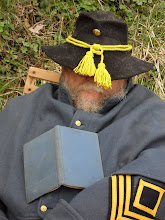
"Alright. Company forward rant!"
I'm reading along, it's getting good, the writer's stuff is really flowing beautifully, the hero checks the clip in his revolver and--THUD!...Jesus, Mary, and Joseph! Don't these people do ANY research?
For some reason known only to the All Mighty, there are a large number of writers out there in the outer darkness who apparently believe they can wing it when it comes to firearms. Rather than burn fifteen minutes online, they make fools of themselves. They will obsess about which train enters which station at a particular hour on Tuesdays and Fridays. They will have nine or ten books piled on their reference table covering the bloodlines of Yorkies. They will have maps of every town that they mention from Roman times to the present in New South Wales. But they will not Google or Yahoo search the word "revolver."
If these folks took the same care while writing about other things, their protagonist would walk out of her yurt, climb up on the fender of the Jugo, slide the canopy back, stick the hand crank in the instrument panel, and with brisk turn fire up its rocket motor.
Why is this? One friend is of the opinion that such writers are afraid of guns and can't bring themselves to think about these devices of the devil. Another postulates that they watch shows on TV and figure that teaches all they need to know (no doubt they also pick up tips on interpersonal relationships from the same shows). I'm told that my contention that they are feeble-minded or bone lazy is too harsh.
Just for my own piece of mind and to, hopefully, keep my blood pressure in check while reading in the future, I will be posting tips from time to time for the firearm-challenged in keyboard land.
Lesson 1: Revolvers
Revolvers do not have either "clips" or magazines. What they have are cylinders. The cartridges (not "bullets" or "shells") are loaded into the cylinder. Each time the hammer (the little lever sticking out the back above your hand) is cocked [single action] or the trigger is pulled [double action] the cylinder revolves (get it?) bringing a unfired round into line with the barrel and firing mechanism.
A cartridge, often called a "round," is composed of a bullet, a propelling charge (either black powder [old] or smokeless powder [modern]), and a cartridge casing (or shell casing). A primer in the base of the cartridge case is stuck by the firearm's firing pin and the propelling charge is set off causing the bullet to travel through the barrel and, after exiting said barrel, hopefully putting a hole in the designated bad guy.
Keep these rules in mind: A magazine holds cartridges. It can be internal (always part of the firearm) or it can be detachable (fits in a well on the firearm). A clip also holds cartridges and is usually pushed into a firearm's internal magazine and is either pulled out by the shooter or is kicked out when the last round is ejected.
Silencers and Revolvers:
You're watching a movie or show and you see the highly paid international assassin pull out a silencer and attach it to his revolver--CUT! Silencers (more properly called suppressors) don't work with revolvers. There is a gap between the front face of the cylinder and the rear end of the barrel. This gap will let the noise out when the revolver is fired even if equipped with a "silencer." For a suppressor to work properly, the action or mechanism must be closed when the cartridge is fired. There are such weapons as suppressed machine pistols. If the suppressor is new, one will hear little sound of the shot but there will be a noticeable chatter of the action operating as it ejects the fired cartridge casings. The whole point of a suppressor is not so much to silence the shot, but to make it sound like something other than a shot.
As a note, during the Vietnam War, two weapons that were nearly silent were issued to U.S. forces.
One was, indeed, a revolver made for the use of tunnel rats. The guys going down in VC holes had a problem with using the U.S. military's standard semi-automatic (fires one round each time the trigger is pulled) .45 caliber M1911A1 pistol. Fire one time in the dark and enclosed places and, between the noise and muzzle flash, you hear and see nothing for a while--not a good feeling. A revolver design was chosen because it is inherently more reliable and idiot-proof than a semi-automatic. The revolver that was issued on a limited basis was made so the cartridge casing actually sealed against the end of the barrel. No muzzle flash and little noise.
The other was a suppressed .22 caliber pistol called a "hush-puppy" issued to the SEALs for neutralizing guard dogs and sentries (DoD sometimes displays a fetish for non-loaded terms like "neutralizing"--as in "We neutralized the guy with three 30 millimeter rounds; then graves registration showed up to take care of the body with a sponge.").
There now, I feel much better. That should hold me until the next time.
19 January 2010: Feast of St. Wulfstan of Worcester, Henry V captures Rouen 1419, San Agustin Church completed in Manila 1607, Capt. Charles Wilks USN circumnavigates Antarctica 1840, Prussians defeat French in Battle of St. Quentin 1871.
Showing posts with label movies. Show all posts
Showing posts with label movies. Show all posts

Lessons from the Muse Online: Part 1
I attended the 2009 Muse Online Writers Conference this Fall. This is part 1 of the work I did for the workshop "World Building in Science Fiction and Fantasy." We started off with a Q & A in which we had to ask ourselves a series of questions to help us develop our settings.
Q. You're writing about the military mostly from the view from the grunt up to the battalion commander (usually a major or light colonel). Why?
A. That's the level I have the most experience with.
Q. Are you writing about armies?
A. No, smaller types of organizations. so far, Fallschirmjagers (drop-troops or future paratroopers who drop from orbit) from Bayern, horse cavalry from High Brazos, Imperial Erin Marines, and the crew of an Imperial Erin destroyer.
Q. Why smaller groups?
A. Camaraderie is usually higher and 'characters" are more likely to end up in such units ("You're asking this of a man who leaves a perfectly good spacecraft to drop from orbit in an egg just so people can shoot at him?").
Q. What kind of situation could a series of short stories be written about?
A. Insurgency tends to be best written about in small chunks, invasions often need a novella, and campaigns require a book. The bigger the operation, the larger the canvas.
Q. What sort of POV?
A. Probably 3rd person limited is best. If you go for 1st person, your narrator has to be everywhere action is taking place. Besides, with 3rd limited, you can occasionally (very occasionally) do a little head-hopping--It's always fun to look at the problems the guy on the other side of the hill is having.
Q. Who's the good guy?
A. That depends on the situation. Normal people tend to think of themselves as the "good guy" (George McDonald Fraser's Harry Flashman doesn't count). It's my job as the writer to limn the characters and their actions in such away that the reader can understand them.
Q. how close to real life can you fly without people reading into the situations and characters commentary you don't intend?
A. as I'm writing about a counterinsurgency, I figure I should make the setting as different from the settings of those going on in the real world as possible.
In my stories, "Words of Rust," "Electronic Propagation," and "Marine Diplomacy," Arkm is described as an "ice world" or "ice ball." In the area my stories are set, the terrain is mostly low-relief. The only heights that have shown up are a dormant shield volcano. As the stories are told from the view point of soldiers fighting an insurgency, the actual science of the planetology hasn't really come up. I see it mostly in this case as something I have to be aware of so nothing jarring jumps up and smacks the reader.
One of my reasons for Arkm's climate and geomorphology was, because I am writing about a counterinsurgency, I wanted to disconnect the stories from things going on at present as much as possible. Because of the subject matter, there will be commonalities. Soldiers have been pretty much the same for the last 8,000 plus years. By definition, insurgency-counterinsurgency has features that don't change (otherwise, it would be some other form of mutual mayhem).
I'll develop Arkm more in part 2.
Review (Note to FTC: I bought this dang book myself!)
Forty Miles a Day on Beans and Hay. by Don Rickey, Jr. Norman, OK: University of Oklahoma Press, 1987.
I've always been a sucker for John Ford's cavalry trilogy: "Fort Apache (1948)," "She Wore a Yellow Ribbon (1949)," and "Rio Grande (1950)." While the cavalrymen were a little better matched in their uniforms when out on patrol (I believe it was Remington who remarked that no two were dressed alike normally), they gave the "right" impression of the soldier's lot--dirt, sweat, exhaustion, and the chance to die in a nameless little clash.
Don Rickey, Jr.'s Forty Miles a Day on Beans and Hay looks at the life of the frontier Regulars from 1865 to the mid 1890s. Unlike many books on this subject and period, it concentrates on the enlisted man's experience. Officers, of course, appear throughout, but it is their interaction with the man in the ranks. The book begins with the enlistment and, almost immediately, one learns what anyone who's been around the military knows, there are the regulations and there is the way things actually work as the recruiter works his magic.
The soldier was often hungry and a look at his diet--dry bread, black coffee, salt beef, (if he was lucky) beans, and hard tack (this was a hard, heavy, plastic-like cracker allegedly made from wheat--men have been known to be killed when hit by a thrown one)--lend convincing proof that our ancestors were a hardy lot. When combined with the knowledge that a private made a princely $13 per month, the fact that the enlistees looked upon such a life as an improvement over that of a civilian is frightening. After reading this section, one may never look upon MREs the same way again.
One also learns of a Sixth Cavalry captain's three lights of the morning--peep o'day, break o'day, and broad daylight, that the first sergeant would be wise to quickly give Private Waller the password at night at 1889's Fort Sill, that General Sheridan knew the difference between Buffalo Bill and buffalo chips, and that rifle cartridges and carbine cartridges could be mixed up to the amusement of all present.
The book finishes with a look at what happened to the survivors after they mustered out.
Shot through Rickey's account is death waiting for its chance, whether through accident, stupidity, sickness, bad water, worse food, heat, cold, homicide, ennui, the unexplained, and, occasionally, action by hostiles.
Read Robert Utley's Frontier Regulars for the campaigns, S.L.A. Marshall's The Crimsoned Prairie for the battles, and Rickey for the soldiers' lives.
DVDs for Christmas (Note to FTC: I bought this dang DVD myself!)
The Birth of Christ: A Christmas Cantata by Andrew T. Miller. Sony Classical. 85 minutes.
On the night of 18 August 2006 in Dublin's Christ Church Cathedral, the Catholic and Protestant choirs used by Handel to premiere his Messiah in 1742 combined to perform the premiere of Andrew T. Miller's The Birth of Christ: A Christmas Cantata. Narrated by Oscar nominee and Golden Globe winner Liam Neeson, this is a relatively new Christmas classic. There is also a CD (to which I'm listening as I write this) available. Definitely good stuff.
8 December 2009: Feast of St. Romaric, Pope Pius IX proclaims Immaculate Conception as dogma 1854, Battle of the Falklands 1914, Japanese invade Hong Kong 1941, U.S.S.R. dissolved and Commonwealth of Independent States established 1991.
Q. You're writing about the military mostly from the view from the grunt up to the battalion commander (usually a major or light colonel). Why?
A. That's the level I have the most experience with.
Q. Are you writing about armies?
A. No, smaller types of organizations. so far, Fallschirmjagers (drop-troops or future paratroopers who drop from orbit) from Bayern, horse cavalry from High Brazos, Imperial Erin Marines, and the crew of an Imperial Erin destroyer.
Q. Why smaller groups?
A. Camaraderie is usually higher and 'characters" are more likely to end up in such units ("You're asking this of a man who leaves a perfectly good spacecraft to drop from orbit in an egg just so people can shoot at him?").
Q. What kind of situation could a series of short stories be written about?
A. Insurgency tends to be best written about in small chunks, invasions often need a novella, and campaigns require a book. The bigger the operation, the larger the canvas.
Q. What sort of POV?
A. Probably 3rd person limited is best. If you go for 1st person, your narrator has to be everywhere action is taking place. Besides, with 3rd limited, you can occasionally (very occasionally) do a little head-hopping--It's always fun to look at the problems the guy on the other side of the hill is having.
Q. Who's the good guy?
A. That depends on the situation. Normal people tend to think of themselves as the "good guy" (George McDonald Fraser's Harry Flashman doesn't count). It's my job as the writer to limn the characters and their actions in such away that the reader can understand them.
Q. how close to real life can you fly without people reading into the situations and characters commentary you don't intend?
A. as I'm writing about a counterinsurgency, I figure I should make the setting as different from the settings of those going on in the real world as possible.
In my stories, "Words of Rust," "Electronic Propagation," and "Marine Diplomacy," Arkm is described as an "ice world" or "ice ball." In the area my stories are set, the terrain is mostly low-relief. The only heights that have shown up are a dormant shield volcano. As the stories are told from the view point of soldiers fighting an insurgency, the actual science of the planetology hasn't really come up. I see it mostly in this case as something I have to be aware of so nothing jarring jumps up and smacks the reader.
One of my reasons for Arkm's climate and geomorphology was, because I am writing about a counterinsurgency, I wanted to disconnect the stories from things going on at present as much as possible. Because of the subject matter, there will be commonalities. Soldiers have been pretty much the same for the last 8,000 plus years. By definition, insurgency-counterinsurgency has features that don't change (otherwise, it would be some other form of mutual mayhem).
I'll develop Arkm more in part 2.
Review (Note to FTC: I bought this dang book myself!)
Forty Miles a Day on Beans and Hay. by Don Rickey, Jr. Norman, OK: University of Oklahoma Press, 1987.
I've always been a sucker for John Ford's cavalry trilogy: "Fort Apache (1948)," "She Wore a Yellow Ribbon (1949)," and "Rio Grande (1950)." While the cavalrymen were a little better matched in their uniforms when out on patrol (I believe it was Remington who remarked that no two were dressed alike normally), they gave the "right" impression of the soldier's lot--dirt, sweat, exhaustion, and the chance to die in a nameless little clash.
Don Rickey, Jr.'s Forty Miles a Day on Beans and Hay looks at the life of the frontier Regulars from 1865 to the mid 1890s. Unlike many books on this subject and period, it concentrates on the enlisted man's experience. Officers, of course, appear throughout, but it is their interaction with the man in the ranks. The book begins with the enlistment and, almost immediately, one learns what anyone who's been around the military knows, there are the regulations and there is the way things actually work as the recruiter works his magic.
The soldier was often hungry and a look at his diet--dry bread, black coffee, salt beef, (if he was lucky) beans, and hard tack (this was a hard, heavy, plastic-like cracker allegedly made from wheat--men have been known to be killed when hit by a thrown one)--lend convincing proof that our ancestors were a hardy lot. When combined with the knowledge that a private made a princely $13 per month, the fact that the enlistees looked upon such a life as an improvement over that of a civilian is frightening. After reading this section, one may never look upon MREs the same way again.
One also learns of a Sixth Cavalry captain's three lights of the morning--peep o'day, break o'day, and broad daylight, that the first sergeant would be wise to quickly give Private Waller the password at night at 1889's Fort Sill, that General Sheridan knew the difference between Buffalo Bill and buffalo chips, and that rifle cartridges and carbine cartridges could be mixed up to the amusement of all present.
The book finishes with a look at what happened to the survivors after they mustered out.
Shot through Rickey's account is death waiting for its chance, whether through accident, stupidity, sickness, bad water, worse food, heat, cold, homicide, ennui, the unexplained, and, occasionally, action by hostiles.
Read Robert Utley's Frontier Regulars for the campaigns, S.L.A. Marshall's The Crimsoned Prairie for the battles, and Rickey for the soldiers' lives.
DVDs for Christmas (Note to FTC: I bought this dang DVD myself!)
The Birth of Christ: A Christmas Cantata by Andrew T. Miller. Sony Classical. 85 minutes.
On the night of 18 August 2006 in Dublin's Christ Church Cathedral, the Catholic and Protestant choirs used by Handel to premiere his Messiah in 1742 combined to perform the premiere of Andrew T. Miller's The Birth of Christ: A Christmas Cantata. Narrated by Oscar nominee and Golden Globe winner Liam Neeson, this is a relatively new Christmas classic. There is also a CD (to which I'm listening as I write this) available. Definitely good stuff.
8 December 2009: Feast of St. Romaric, Pope Pius IX proclaims Immaculate Conception as dogma 1854, Battle of the Falklands 1914, Japanese invade Hong Kong 1941, U.S.S.R. dissolved and Commonwealth of Independent States established 1991.
When good vegetarians turn bad.
Being a connoisseur (stress on "sewer") of giant monster movies, I have been struck by the great acting wasted in many of them. In "Night of the Lepus," (1972) Sheriff Cody, played by Paul Fix (see below), manages to deliver the following line in a dead straight, no nonsense, policeman doing his duty manner: "Ladies and gentlemen, may I have your attention. There is a herd of killer rabbits headed this way." This man should have gotten an Oscar for being able to get that out with a straight face. In the gang my wife and I hung out with when we were first married, trying to equal Fix's performance was a test no one was able to pass. Most of us were okay until we got about to the word "herd," then we fell apart. It's still a great party game for science fiction/fantasy fans.
Which brings to mind a question: Why would giant herbivores turn into carnivores in a desert? According to the plot of "Night of the Lepus," the rabbits, growing to gigantic size, switched from vegetation to meat as a food source. This also shows up in the movie "Them" (1954) when Joan Weldon, playing Dr. Pat Medford (the pretty one), remarks about the giant ants, that with the lack of forage, "...they'd have to turn carnivorous." Huh? Looking at the American Southwest's deserts, there's a heck of a lot more biomass available in vegetation than large prey species (well, yeah, there is Sun City). Most likely the dedicated herbivores would have died of starvation before they developed into dedicated carnivores if the situation was that dire. Of course, they could have gone only half way and joined us and bears as omnivores (would you care for a small steak with your salad, sir?). Being multi fueled is a pretty good strategy sometimes. One could consider carnivorous rabbits as something of a throw-back when you figure mammals started out as a bunch of bug-snatchers (this might explain why some of my relatives, as Jeff Foxworthy's wont to suggest, consider a six pack and a bug-zapper as a fine evening's entertainment). I realize for the sake of the story the giant whatevers have to chow down on people (that good old chill up the small mammal's spine) and the desert is spooky and handy to Hollywood, but for the biology types a little cringe comes with it.
26 November 2009: Feast of St. Conrad of Constance, Thanksgiving (U.S.), blizzard of 1896-North Dakota, Note: Tomorrow it becomes legal to play Christmas music in 23 states.
Which brings to mind a question: Why would giant herbivores turn into carnivores in a desert? According to the plot of "Night of the Lepus," the rabbits, growing to gigantic size, switched from vegetation to meat as a food source. This also shows up in the movie "Them" (1954) when Joan Weldon, playing Dr. Pat Medford (the pretty one), remarks about the giant ants, that with the lack of forage, "...they'd have to turn carnivorous." Huh? Looking at the American Southwest's deserts, there's a heck of a lot more biomass available in vegetation than large prey species (well, yeah, there is Sun City). Most likely the dedicated herbivores would have died of starvation before they developed into dedicated carnivores if the situation was that dire. Of course, they could have gone only half way and joined us and bears as omnivores (would you care for a small steak with your salad, sir?). Being multi fueled is a pretty good strategy sometimes. One could consider carnivorous rabbits as something of a throw-back when you figure mammals started out as a bunch of bug-snatchers (this might explain why some of my relatives, as Jeff Foxworthy's wont to suggest, consider a six pack and a bug-zapper as a fine evening's entertainment). I realize for the sake of the story the giant whatevers have to chow down on people (that good old chill up the small mammal's spine) and the desert is spooky and handy to Hollywood, but for the biology types a little cringe comes with it.
For more on this, you may want to get a hold of a copy of: Fudd, R.E. "Giagantism as displayed in some specimens of Oryctolagus cuniculus from the Basin and Range Province, Western North America." 1973. Extracts in Papers on Late Holocene Mammals from the American Southwest. Ed. B. Bonnie, Oswald Rarebit and Fr. R.A. Hare, S.J. Berkeley: University of California, 1996. 337-452.
Paul Fix (1901-1983) appeared in 350 roles in movies and TV starting in 1927 (he appeared in 27 John Wayne movies alone). He started as a smooth heavy then moved into character roles such as Marshal Micah Torrance in the ABC show, "The Rifleman" (1958-1963), starring Chuck Conners.
Christmas Gift Idea:
Bird Watcher's Digest. http://birdwatchersdigest.com/
This bimonthly digest-sized magazine kind of snuck up on me. I tripped over it for the first time at the supermarket. The pictures are nice and the writing is well done.
A story that jumped out at me from the November/December 2009 issue concerned the rediscovery of a forest owlet thought to be extinct 100 years in India. Mixed up in this was the Richard Meinertzhagen affair. This was gravy to me as Meinertzhagen (remember the staff officer and his trick in the movie "The Light Horsemen?") and his doings are of especial interest to me.
26 November 2009: Feast of St. Conrad of Constance, Thanksgiving (U.S.), blizzard of 1896-North Dakota, Note: Tomorrow it becomes legal to play Christmas music in 23 states.
Subscribe to:
Posts (Atom)