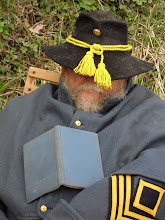
Main battles picked for 150th anniversary observance of the War Between the States/American Civil War.
A mite late for Lee-Jackson Day, but the American Civil War re-enactor groups' leaders have decided which battle re-enactments will be endorsed. Meeting in Chickamauga, Georgia, members of the Civil War 150th National Leadership Convention representing 12,000 re-enactors voted for the following battle observances:
2011
First Manassas/Bull Run -- Virginia
Shiloh -- Tennessee
2012
Second Manassas/Bull Run -- Virginia
Vicksburg -- Mississippi
2013
Gettysburg -- Pennsylvania
Chickamauga -- Georgia
2014
The Wilderness -- Virginia
Atlanta -- Georgia
2015
Bentonville -- North Carolina
Appomattox Court House -- Virginia
I used to take part in re-enacting back when I could move around better. I was a private in a Virginia Volunteer Infantry company or a Pennsylvania Volunteer Infantry company (depending on which side was needed more--Federals outnumbered four to one by Confederates is just silly). After a while, I got old and tired and my case of Civil War bloat was just too embarrassing [see note]. Now adays, on those rare occasions I can get outside to attend a re-enactment, I stand on the sidelines with the other gawkers and dream. If I can manage it, I plan to see the sesquicentennial through as I did the centennial, though I admit the bicentennial might possibly be a bit of a stretch.
Note: Civil War Bloat.
Civil War bloat is a condition in which the re-enactor appears to has been dead in the sun for three days during the hot summer of 1863 while still standing up. It is brought on by age, a lack of regular exercise, and a wife who is far too good a cook. It is especially weird looking when the affected soldier is dressed in gray or butternut (putting the lie to the hard times in the South). The overly common amount of gray hair (if any) that often accompanies it also calls into question the fact that the men on both sides normally ranged in age from 16 to 35. This condition effects not only Civil War re-enactors, but those of many other periods. I've noted it at Alesia, Waterloo, Rorke's Drift, the Somme, and Normandy. The problem is old guys are the ones who have the bucks to shell out $600 for their wool trousseau (uniform, equipment, and rifle musket) and the time to burn on summer weekends out in the middle of nowhere (the young guys seem rather more intent on chasing girls for some reason).
Occasionally though, one does run across a unit of young, dirty, sweaty, ragged, skinny men in gray or blue and one realizes he is looking at his own great-great grandfather.
22 January 2010: Feast of St. Brithward of Ramsbury. Ashantis defeat British on Gold Coast 1824, Battles of Isandlwana and Rorke's Drift 1879, Commonwealth forces capture Tobruk from Italians 1941, Anzio landings 1944.
Showing posts with label cavalry. Show all posts
Showing posts with label cavalry. Show all posts

Lessons from the Muse Online: Part 1
I attended the 2009 Muse Online Writers Conference this Fall. This is part 1 of the work I did for the workshop "World Building in Science Fiction and Fantasy." We started off with a Q & A in which we had to ask ourselves a series of questions to help us develop our settings.
Q. You're writing about the military mostly from the view from the grunt up to the battalion commander (usually a major or light colonel). Why?
A. That's the level I have the most experience with.
Q. Are you writing about armies?
A. No, smaller types of organizations. so far, Fallschirmjagers (drop-troops or future paratroopers who drop from orbit) from Bayern, horse cavalry from High Brazos, Imperial Erin Marines, and the crew of an Imperial Erin destroyer.
Q. Why smaller groups?
A. Camaraderie is usually higher and 'characters" are more likely to end up in such units ("You're asking this of a man who leaves a perfectly good spacecraft to drop from orbit in an egg just so people can shoot at him?").
Q. What kind of situation could a series of short stories be written about?
A. Insurgency tends to be best written about in small chunks, invasions often need a novella, and campaigns require a book. The bigger the operation, the larger the canvas.
Q. What sort of POV?
A. Probably 3rd person limited is best. If you go for 1st person, your narrator has to be everywhere action is taking place. Besides, with 3rd limited, you can occasionally (very occasionally) do a little head-hopping--It's always fun to look at the problems the guy on the other side of the hill is having.
Q. Who's the good guy?
A. That depends on the situation. Normal people tend to think of themselves as the "good guy" (George McDonald Fraser's Harry Flashman doesn't count). It's my job as the writer to limn the characters and their actions in such away that the reader can understand them.
Q. how close to real life can you fly without people reading into the situations and characters commentary you don't intend?
A. as I'm writing about a counterinsurgency, I figure I should make the setting as different from the settings of those going on in the real world as possible.
In my stories, "Words of Rust," "Electronic Propagation," and "Marine Diplomacy," Arkm is described as an "ice world" or "ice ball." In the area my stories are set, the terrain is mostly low-relief. The only heights that have shown up are a dormant shield volcano. As the stories are told from the view point of soldiers fighting an insurgency, the actual science of the planetology hasn't really come up. I see it mostly in this case as something I have to be aware of so nothing jarring jumps up and smacks the reader.
One of my reasons for Arkm's climate and geomorphology was, because I am writing about a counterinsurgency, I wanted to disconnect the stories from things going on at present as much as possible. Because of the subject matter, there will be commonalities. Soldiers have been pretty much the same for the last 8,000 plus years. By definition, insurgency-counterinsurgency has features that don't change (otherwise, it would be some other form of mutual mayhem).
I'll develop Arkm more in part 2.
Review (Note to FTC: I bought this dang book myself!)
Forty Miles a Day on Beans and Hay. by Don Rickey, Jr. Norman, OK: University of Oklahoma Press, 1987.
I've always been a sucker for John Ford's cavalry trilogy: "Fort Apache (1948)," "She Wore a Yellow Ribbon (1949)," and "Rio Grande (1950)." While the cavalrymen were a little better matched in their uniforms when out on patrol (I believe it was Remington who remarked that no two were dressed alike normally), they gave the "right" impression of the soldier's lot--dirt, sweat, exhaustion, and the chance to die in a nameless little clash.
Don Rickey, Jr.'s Forty Miles a Day on Beans and Hay looks at the life of the frontier Regulars from 1865 to the mid 1890s. Unlike many books on this subject and period, it concentrates on the enlisted man's experience. Officers, of course, appear throughout, but it is their interaction with the man in the ranks. The book begins with the enlistment and, almost immediately, one learns what anyone who's been around the military knows, there are the regulations and there is the way things actually work as the recruiter works his magic.
The soldier was often hungry and a look at his diet--dry bread, black coffee, salt beef, (if he was lucky) beans, and hard tack (this was a hard, heavy, plastic-like cracker allegedly made from wheat--men have been known to be killed when hit by a thrown one)--lend convincing proof that our ancestors were a hardy lot. When combined with the knowledge that a private made a princely $13 per month, the fact that the enlistees looked upon such a life as an improvement over that of a civilian is frightening. After reading this section, one may never look upon MREs the same way again.
One also learns of a Sixth Cavalry captain's three lights of the morning--peep o'day, break o'day, and broad daylight, that the first sergeant would be wise to quickly give Private Waller the password at night at 1889's Fort Sill, that General Sheridan knew the difference between Buffalo Bill and buffalo chips, and that rifle cartridges and carbine cartridges could be mixed up to the amusement of all present.
The book finishes with a look at what happened to the survivors after they mustered out.
Shot through Rickey's account is death waiting for its chance, whether through accident, stupidity, sickness, bad water, worse food, heat, cold, homicide, ennui, the unexplained, and, occasionally, action by hostiles.
Read Robert Utley's Frontier Regulars for the campaigns, S.L.A. Marshall's The Crimsoned Prairie for the battles, and Rickey for the soldiers' lives.
DVDs for Christmas (Note to FTC: I bought this dang DVD myself!)
The Birth of Christ: A Christmas Cantata by Andrew T. Miller. Sony Classical. 85 minutes.
On the night of 18 August 2006 in Dublin's Christ Church Cathedral, the Catholic and Protestant choirs used by Handel to premiere his Messiah in 1742 combined to perform the premiere of Andrew T. Miller's The Birth of Christ: A Christmas Cantata. Narrated by Oscar nominee and Golden Globe winner Liam Neeson, this is a relatively new Christmas classic. There is also a CD (to which I'm listening as I write this) available. Definitely good stuff.
8 December 2009: Feast of St. Romaric, Pope Pius IX proclaims Immaculate Conception as dogma 1854, Battle of the Falklands 1914, Japanese invade Hong Kong 1941, U.S.S.R. dissolved and Commonwealth of Independent States established 1991.
Subscribe to:
Posts (Atom)