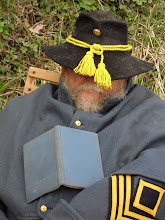
"Er, I'm not sure you want to do that."
A question came up over on the Historical Mystery Writer's Yahoo list the other day asking if anyone could think of a story in which mismatched ammunition in a firearm was used as a clue. I can't think of one, but it is a good idea for a clue. One of the other writers pointed out that using the wrong ammunition could result in an explosion. I suggested Jimmy Breslin's book, The Gang Who Couldn't Shoot Straight as an hilarious illustration of this.
The subject brought to mind some of the things dad and his brothers did back up on the Blue Ridge.
The youngest brother (there were six and I use no names for my own safety--I'm not sure of the statute of limitation with some of the things that went on) was stuck with an ancient 12 gauge single barrel shotgun for his first deer hunt with his brothers. As ammunition, he found a half box of 14 gauge shells around the house, a rare and unlamented gauge (in that part of the world, a gladius wouldn't surprise me). [Note to the firearms-challenged: As the gauge number in shotguns goes up, the bore of the shotgun and its chamber gets smaller--and I'm too lazy at the moment to go see why this came about. Maybe in a later "Son of a Gun" post] The next day, as the brothers move through the upper sinkhole field on their farm, the older ones spook a doe toward the youngest. Figuring the deer was in little danger from their brother and to watch the fun, they shout to him, "Here's one!" The youngest throws the shotgun to his shoulder, takes aim at the oncoming doe with both eyes wide (direction of target: plus or minus 90 degrees), jerks the trigger, and is rewarded with a satisfying "click." He breaks the breech of the shotgun to remove and replace the dud round and finds that the 14 gauge shell has slid down the chamber where the firing pin can't strike its primer cap and is now jammed until the good Lord calls us all home. The panicked doe now on him, he reverses the shotgun and hits her with the buttstock (as one of his admiring brothers described it, "A buttstroke my old sergeant would have envied."). The doe steps back then bolts around him and off into the mountains. Somehow, he survived his brothers regaling two counties with the story and went on to be a pretty fair hunter.
One of my uncles brought back a Japanese Arisaka Type 99 bolt-action rifle from the Pacific (on a bolt-action weapon, a lever rotates a cylindrical "bolt" unlocking the action, the bolt is pulled rearward which opens the action or chamber allowing a fired cartridge casing to fly out, the bolt is then pushed forward stripping an unfired cartridge from the magazine [remember last "Son of a Gun?"] and pushing it into the chamber, the lever rotates the bolt locking the action, and the weapon is ready to fire). The Type 99 was chambered for 7.7x58mm and, as this was a early war model, was an accurate shooter. The problem was that that type of ammunition tended to be a bit rare in the general stores in that part of the Blue Ridge Mountains. 30.06 on the other hand was quite common. The problem is the 7.7mm cartridge casing is just a little wider than that of the 30.06, causing the 30.06 round not to feed correctly. To remedy this, one of the brothers took a Prince Albert pipe tobacco can, sans top and bottom, flattened it then folded it and inserted it into the rifle's internal magazine on the left side. After that, the 30.06 rounds fed just fine and the brothers took eight deer that I know of with it (while a teen, I managed to miss two deer myself with it). Interestingly, that Arisaka still had the Imperial Chrysanthemum stamp on the receiver showing that the rifle had been captured rather than surrendered (an order came down from Imperial Army and Navy headquarters toward the end of the war to grind off the chrysanthemum from rifles so that the Emperor would not be dishonored). Also the anti-aircraft calipers were missing from the rear sights (you've got to love the military mind, anti-aircraft sights on a bolt-action rifle--of course if a plane had to fly through the rifle fire from a battalion at low altitude, somebody might get lucky--but I'll bet it wasn't aimed fire).
Well, I smell the bouquet of the wife's chili wafting from the kitchen. Dismissed.
8 March 2010: Feast of St. Beoadh of Ardcarne. Ansbach and Bayreuth regiments--later captured with Cornwallis at Yorktown--initially mutiny at Ochsenfurt rather than serve British in American colonies 1777, CSS Virginia (ex USS Merrimack) launched at Hampton Roads 1862, Dutch forces on Java surrender to Japanese 1942, Nelson's Pillar in Dublin blown up by Irish 1966.
Showing posts with label deer hunting. Show all posts
Showing posts with label deer hunting. Show all posts

The desert and the story teller.
For the teller of stories, the desert is often the place of the other. A place outside the world of settled man where strange and dangerous things and men move just on the edge of perception. It is seen as a place where anything can happen because the laws of normality don't apply there. The desert is a dimension from which monsters and raiders come. This still holds true for story telling today. It is probably no accident Stephen King set a large part of The Stand in the desert or that Michael Crichton placed the "Wildfire" lab in The Andromeda Strain there. Hollywood loves it as a setting. It's close, spooky, timeless, and relatively cheap in which to shoot a movie.
The thing that really hits you about the desert is the silence. It's not just quiet, sometimes, when there's no wind or flies, sound hasn't been invented yet. This affects people in different ways. Some try to be as quiet as possible. As if the least sound they make is deafening and may lead some doom down upon them. Others go the other direction. They try to fill up the silence all by themselves. They sing, talk, and make music much louder than is their wont when in civilization (or what passes for such). They seem to fear that the silence will suck away the sounds, so they must supply a surplus to even it out.
The desert blasts not only objects, but people also. It sometimes seems that anyone who lives alone long enough in the high desert ends up either a saint or a mass murderer.
For the writer, the desert is always there waiting. It would be terrible to waste it.
Buck Fever: The Deer Hunting Tradition in Pennsylvania. Mike Sajna. Pittsburgh: University of Pittsburgh Press, 1990.
Late November is special to me. Three major events in my life collide at that point in this month: my birthday, Thanksgiving, and deer season west of Blue Ridge. The week of Thanksgiving meant I would get to miss school for a week, much to the shared relief of both student and teachers (back before school administrators were under the impression that children belonged to them, it was sufficient that my mom sent in a note saying I wouldn't be in school the next week). Season opened in Virginia's Rockbridge and Augusta Counties the Saturday morning before Thanksgiving. So my daddy and I loaded the truck when he got home Friday afternoon and, after dinner with my mom, the two of us would head southwest. We'd get to the camp about 22:00 [10:00 pm] and be unloaded and in bed by 23:30 [11:30 am]. Ah, to sleep (like that was going to happen with deer season opening at daybreak). During the rest of the dark hours, the rest of the family, in-laws, and outlaws straggled into camp making sure to be in time for breakfast. Then, gray in the eastern sky, we headed for our spots on the mountain where we'd take that six, eight, or--can it be?--the thirty point buck.
Mike Sajna writes about one deer season at his family's deer camp in Warren County on Pennsylvania's Allegheny High Plateau. We meet the various members of his own platoon of the "pumpkin army." The hunters depicted are recognizable to everyone who has hunted with good hunters as opposed to the game hogs, drunks, and hunting slobs one hears about all too often. The Yoopers they ain't.
The reader also learns that deer hunting was destroyed in Pennsylvania by market hunting in the 19th century. How a group of hunters got together and started the state's first conservation organization, the Pennsylvania State Sportsmen's Association, which led in turn to the Pennsylvania Game Commission in 1895. Sajna tells of John MacFarlane Phillips who, horrified at the thought that he had killed the last deer in the state, set out to put the matter right. And put the matter right he did. Through his and his fellow hunters efforts, deer were successfully reintroduced to the state's woods. Upon his death at 92 in 1953, The Pittsburgh Sun-Telegraph called him the "Grand Old Man of Conservation."
Best, Sajna limns the relationship between he and his father as hunters, men, and father and son.
Buck Fever is not a book only for hunters; it will show the non-hunter what goes on in and around a proper deer camp. This is a book that works on many levels as Sajna blends the several interrelated story lines in such a way that each compliments the others and builds a strong and enjoyable whole.
24 November 2009: Feast of St. Andrew Dung-Lac & companions, publication of Charles Darwin's On the Origin of Species 1859, my birthday (you win some, you lose some).
The thing that really hits you about the desert is the silence. It's not just quiet, sometimes, when there's no wind or flies, sound hasn't been invented yet. This affects people in different ways. Some try to be as quiet as possible. As if the least sound they make is deafening and may lead some doom down upon them. Others go the other direction. They try to fill up the silence all by themselves. They sing, talk, and make music much louder than is their wont when in civilization (or what passes for such). They seem to fear that the silence will suck away the sounds, so they must supply a surplus to even it out.
The desert blasts not only objects, but people also. It sometimes seems that anyone who lives alone long enough in the high desert ends up either a saint or a mass murderer.
For the writer, the desert is always there waiting. It would be terrible to waste it.
Review (Note to FTC: I bought this dang book myself!)
Buck Fever: The Deer Hunting Tradition in Pennsylvania. Mike Sajna. Pittsburgh: University of Pittsburgh Press, 1990.
Late November is special to me. Three major events in my life collide at that point in this month: my birthday, Thanksgiving, and deer season west of Blue Ridge. The week of Thanksgiving meant I would get to miss school for a week, much to the shared relief of both student and teachers (back before school administrators were under the impression that children belonged to them, it was sufficient that my mom sent in a note saying I wouldn't be in school the next week). Season opened in Virginia's Rockbridge and Augusta Counties the Saturday morning before Thanksgiving. So my daddy and I loaded the truck when he got home Friday afternoon and, after dinner with my mom, the two of us would head southwest. We'd get to the camp about 22:00 [10:00 pm] and be unloaded and in bed by 23:30 [11:30 am]. Ah, to sleep (like that was going to happen with deer season opening at daybreak). During the rest of the dark hours, the rest of the family, in-laws, and outlaws straggled into camp making sure to be in time for breakfast. Then, gray in the eastern sky, we headed for our spots on the mountain where we'd take that six, eight, or--can it be?--the thirty point buck.
Mike Sajna writes about one deer season at his family's deer camp in Warren County on Pennsylvania's Allegheny High Plateau. We meet the various members of his own platoon of the "pumpkin army." The hunters depicted are recognizable to everyone who has hunted with good hunters as opposed to the game hogs, drunks, and hunting slobs one hears about all too often. The Yoopers they ain't.
The reader also learns that deer hunting was destroyed in Pennsylvania by market hunting in the 19th century. How a group of hunters got together and started the state's first conservation organization, the Pennsylvania State Sportsmen's Association, which led in turn to the Pennsylvania Game Commission in 1895. Sajna tells of John MacFarlane Phillips who, horrified at the thought that he had killed the last deer in the state, set out to put the matter right. And put the matter right he did. Through his and his fellow hunters efforts, deer were successfully reintroduced to the state's woods. Upon his death at 92 in 1953, The Pittsburgh Sun-Telegraph called him the "Grand Old Man of Conservation."
Best, Sajna limns the relationship between he and his father as hunters, men, and father and son.
Buck Fever is not a book only for hunters; it will show the non-hunter what goes on in and around a proper deer camp. This is a book that works on many levels as Sajna blends the several interrelated story lines in such a way that each compliments the others and builds a strong and enjoyable whole.
24 November 2009: Feast of St. Andrew Dung-Lac & companions, publication of Charles Darwin's On the Origin of Species 1859, my birthday (you win some, you lose some).
Subscribe to:
Posts (Atom)