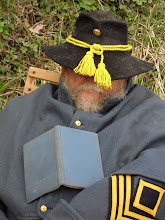
"Er, I'm not sure you want to do that."
A question came up over on the Historical Mystery Writer's Yahoo list the other day asking if anyone could think of a story in which mismatched ammunition in a firearm was used as a clue. I can't think of one, but it is a good idea for a clue. One of the other writers pointed out that using the wrong ammunition could result in an explosion. I suggested Jimmy Breslin's book, The Gang Who Couldn't Shoot Straight as an hilarious illustration of this.
The subject brought to mind some of the things dad and his brothers did back up on the Blue Ridge.
The youngest brother (there were six and I use no names for my own safety--I'm not sure of the statute of limitation with some of the things that went on) was stuck with an ancient 12 gauge single barrel shotgun for his first deer hunt with his brothers. As ammunition, he found a half box of 14 gauge shells around the house, a rare and unlamented gauge (in that part of the world, a gladius wouldn't surprise me). [Note to the firearms-challenged: As the gauge number in shotguns goes up, the bore of the shotgun and its chamber gets smaller--and I'm too lazy at the moment to go see why this came about. Maybe in a later "Son of a Gun" post] The next day, as the brothers move through the upper sinkhole field on their farm, the older ones spook a doe toward the youngest. Figuring the deer was in little danger from their brother and to watch the fun, they shout to him, "Here's one!" The youngest throws the shotgun to his shoulder, takes aim at the oncoming doe with both eyes wide (direction of target: plus or minus 90 degrees), jerks the trigger, and is rewarded with a satisfying "click." He breaks the breech of the shotgun to remove and replace the dud round and finds that the 14 gauge shell has slid down the chamber where the firing pin can't strike its primer cap and is now jammed until the good Lord calls us all home. The panicked doe now on him, he reverses the shotgun and hits her with the buttstock (as one of his admiring brothers described it, "A buttstroke my old sergeant would have envied."). The doe steps back then bolts around him and off into the mountains. Somehow, he survived his brothers regaling two counties with the story and went on to be a pretty fair hunter.
One of my uncles brought back a Japanese Arisaka Type 99 bolt-action rifle from the Pacific (on a bolt-action weapon, a lever rotates a cylindrical "bolt" unlocking the action, the bolt is pulled rearward which opens the action or chamber allowing a fired cartridge casing to fly out, the bolt is then pushed forward stripping an unfired cartridge from the magazine [remember last "Son of a Gun?"] and pushing it into the chamber, the lever rotates the bolt locking the action, and the weapon is ready to fire). The Type 99 was chambered for 7.7x58mm and, as this was a early war model, was an accurate shooter. The problem was that that type of ammunition tended to be a bit rare in the general stores in that part of the Blue Ridge Mountains. 30.06 on the other hand was quite common. The problem is the 7.7mm cartridge casing is just a little wider than that of the 30.06, causing the 30.06 round not to feed correctly. To remedy this, one of the brothers took a Prince Albert pipe tobacco can, sans top and bottom, flattened it then folded it and inserted it into the rifle's internal magazine on the left side. After that, the 30.06 rounds fed just fine and the brothers took eight deer that I know of with it (while a teen, I managed to miss two deer myself with it). Interestingly, that Arisaka still had the Imperial Chrysanthemum stamp on the receiver showing that the rifle had been captured rather than surrendered (an order came down from Imperial Army and Navy headquarters toward the end of the war to grind off the chrysanthemum from rifles so that the Emperor would not be dishonored). Also the anti-aircraft calipers were missing from the rear sights (you've got to love the military mind, anti-aircraft sights on a bolt-action rifle--of course if a plane had to fly through the rifle fire from a battalion at low altitude, somebody might get lucky--but I'll bet it wasn't aimed fire).
Well, I smell the bouquet of the wife's chili wafting from the kitchen. Dismissed.
8 March 2010: Feast of St. Beoadh of Ardcarne. Ansbach and Bayreuth regiments--later captured with Cornwallis at Yorktown--initially mutiny at Ochsenfurt rather than serve British in American colonies 1777, CSS Virginia (ex USS Merrimack) launched at Hampton Roads 1862, Dutch forces on Java surrender to Japanese 1942, Nelson's Pillar in Dublin blown up by Irish 1966.
Showing posts with label World War II. Show all posts
Showing posts with label World War II. Show all posts

Of "Chained Dogs" and females.
Here is another chunk of Chained Dogs.
Preface
My father, Dr. Wilhelm Kluge, died in a traffic accident in the American city of Phoenix while on his way to take part in a study of dark matter at the Vatican Advanced Technology Telescope (VATT) at Mount Graham in the southeastern part of the State of Arizona.
Among his papers was found the following story. It speaks of a short period during Germany's war in North Africa. My father, like many veterans rarely spoke of his experiences in World War II. The most that he shared with us, his wife and children, were a few happy, often comic, interludes.
Reading the story while going through his papers, I found the answer to a few questions raised in the mind of the family by some of his actions. One was why my father named our older brother "Conrad," a name that appears on neither side of the family. A second was why he occasionally used phrases and terms more usual in Upper Bavaria. A third was his habit of going to Munich's Catholic Cathedral, the Frauenkirche, each Friday to light a candle though a confirmed Lutheran. And, fourth, his amassing a large collection of English and American books between the end of the war and his death that had nothing to do with his profession.
My father's writing was clear and crisp. I have had to make very few editorial changes. Thus, it speaks with his voice.
I am indebted to my Canadian wife, Sally, for help with the translation of his story from German to English. If there are mistakes in the manuscript, they are wholly mine.
Manfred Paul Kluge
Munich: 24 December 2008
Is the female of the species, Homo sapiens sapiens, a mammalian ectotherm?
It has come to my attention during the well over half a century I have been observing (including the thirty-four years of my marriage) that the female of our species is apparently a form of mammalian ectotherm [see below]. Through the period of observation, the women in my life have generally complained of low-temperature environmental effects at any temperature below 32 degrees C (90 degrees F). The affect of these declarations is the adjustment of thermal controls to a temperature level incompatable to comfortable survival for the male of the species. This leads to any number of coping strategies such as standing on porches in sub-zero weather for purposes of thermal regulation rather than more normal activities of smoking a really good cigar, or removal of outer coverings to achieve the same outcomes (which explains why, as usual, the writer is sitting in his skivies as he types this).
Professor Jeffrey M. Foxworthy has this noted this, to females, common feature. In his academic work, he points out that ice cold feet in the small of the back at oh-dark-thirty is the norm. He further reported that the men observed sitting in statiums in freezing temperatures stripped to the waist are not, as commonly thought, drunk. Rather they are escorts of significant others who have stripped them of their clothing because "I'm cold."
All this leads to the possible explanation that the female Homo sapiens sapiens is indeed an ectotherm and, thus, unable to regulate her internal temperature. Rather than controlling her internal temperatures, she instead controls her climatic environment, often to the detriment of the males of the species in the immediate area.
Note: An ectotherm is an animal that is unable to regulate its internal temperature independant of its environment. An endotherm such as the male of Homo sapiens sapiens regulates its internal temperature independant of the environment.
4 December 2009: Feast of St. Osmund of Salisbury, Crusaders capture Sidon 1110, Suttee outlawed by Raj 1829, Mary Celeste found abandoned 1872, Marine Raider Long Patrol - Guadalcanal 1942.
Subscribe to:
Posts (Atom)